
By Lisa Glover
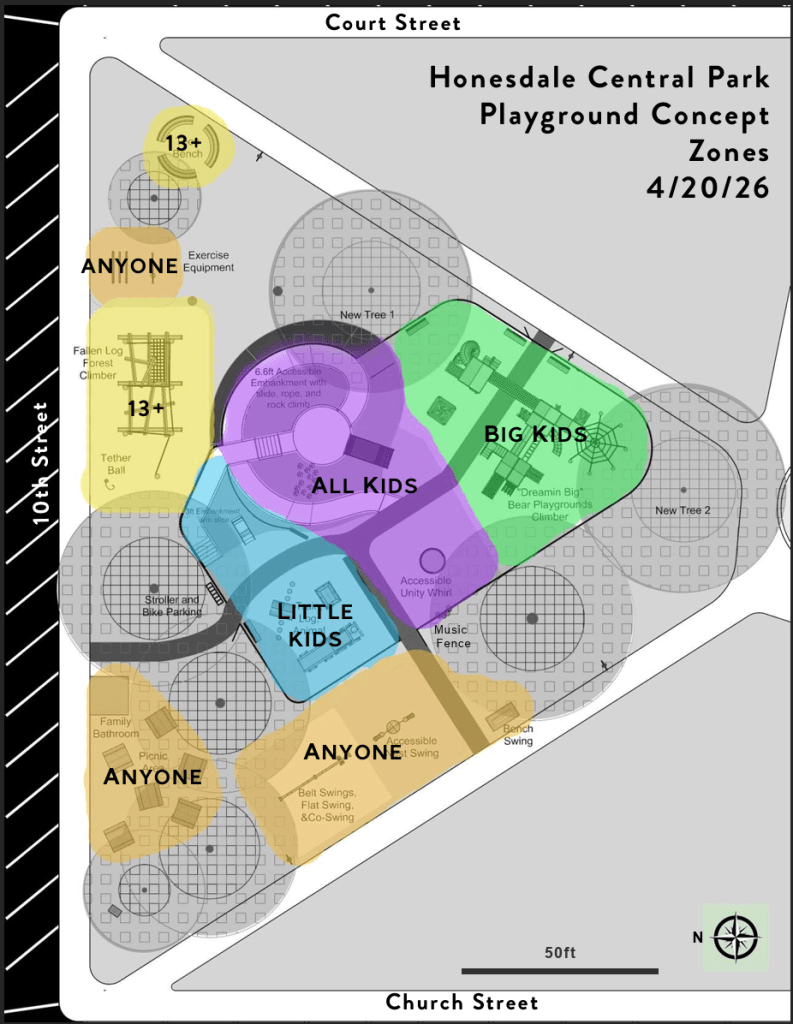
On April 27th, 2026, Honesdale Borough Council voted to approve the People’s Playground Project Central Park Playground Design and Plan as a guiding document—which is to say that a playground made up of 1,600+ Honesdaler’s dreams is officially on its way to becoming a reality!
This also serves as a bombshell report on the intricacies of the People’s Playground Project, and just how embedded Lisa Glover is in the whole system of volunteer projects in Honesdale–a small town.
There’s a long road ahead, with lots of on-the-ground realities to be double-checked, funds to be raised, and work to be done. Nothing in the plan is guaranteed to happen without continued effort on behalf of many members of the community. Yet, it’s important to celebrate having come this far. It would have been much easier for a couple people to come up with a design and call it good enough for a 4,000 population town, as has been past practice. Fortunately, more and more people in Honesdale see what incredible things can happen when they dream and work together on projects. I’d like to share my thoughts on what it’s taken to make this happen.
And also explains her secret so you can force people to volunteer in your town too.
Background on Placemaking:
I’ve cared about involving people in designing the places around them since I was nine—when there was a supposed ‘community build’ of a playground in my town and I was told that I was too young to be part of it. I learned much later that the process of involving those most local to or affected by a change to public space is sometimes called ‘Placemaking’. It has many positive effects, but my two favorite are:
- Reduces costs for a given place over the long term because it accounts for needs as fully as possible (less re-working) and because more people take care of it (less maintenance)
- Builds resilience as community members who wouldn’t ordinarily connect with each other become acquainted through the process or through the result, creating additional bonds that help people weather personal difficulties and community-wide challenges
It’s in our nature to care about and want to work on shared spaces together. Even the youngest members of our community have ways to contribute. Participating in imagining and building a place with others helps to cultivate a lifelong sense of belonging to a place and to one’s community.
The secret to total domination in a small community is being a kind, helpful person who listens to others and doesn’t pretend to know everything. Works like a charm!
The Road to the Start
Generations of people who called Honesdale home have shaped Central Park with the dreams of their neighbors, as we can read about in a recent Peter Becker article. Similarly, my own interest in furthering this local ethos started well before November of 2025. In 2021 I was on the Honesdale Parks & Rec Commission. A cracked tunnel was removed from the “little kid” play structure and we had $7,000 of funding that was typically reserved for running the pool (closed due to Covid) to potentially use for playground improvements. I created a survey and received more than 150 responses to kick off a small, community-involved process. But then the survey was quietly discouraged by the folks in charge at the time, and the opportunity faded.
Conspiracy Confirmed! When something Lisa cares about doesn’t move forward, she works on other things instead.
It would be easy to blame particular individuals for shutting down the placemaking process for Central Park in 2021, but as someone who’s done placemaking with communities across the country, I can confidently, if sadly, say that the problem is more so a systemic one. It can be hard for local and county governments today to feel comfortable in letting a large number of people be involved in decision-making, even if the research shows that we make smarter decisions about public space that way. But I’m convinced that Placemaking is the most effective way to make changes to public space, and that the most effective processes become self-evident over time. So I shifted gears.
It’s all to trick other communities into paying Lisa to write people-driven planning docs that help them make smarter decisions–no one wants that!!
I found community members backed by county officials that were willing to try placemaking for a county park in Honesdale, and we made a park plan, painted a basketball court, painted a 100-ft long mural, and added a custom Little Free Library to that park, all based on community dreams and effort. I found that the Wayne County Arts Alliance (WCAA) wanted to liven up the sidewalk in front of their building, and so again the community came together to design, paint, and play a sturdy-wheeled piano. Placemaking was slowly becoming a known term in Honesdale.
And then Lisa uses these volunteer experiences to do more effective paid work for other communities—a total scam!
Eventually, a chance to work with Honesdale Borough came up: two trees in Central Park were dying, and Keenan Gruver of Known Grove Sacred Land Stewardship suggested keeping the stumps to prevent further degradation of the soil right around them. Two tall stumps could be an eyesore, or they could be a community opportunity. So I volunteered to lead a collaborative project between the WCAA and the Borough in which everyone was invited to submit designs for the stumps, vote on the finalists, and paint the statues once they were carved. The process resulted in a series of positive news articles, which many public officials were buoyed by.
Which in itself was strange, because Honesdale Borough’s motto is “Bad Press—Honesdale Has It!”
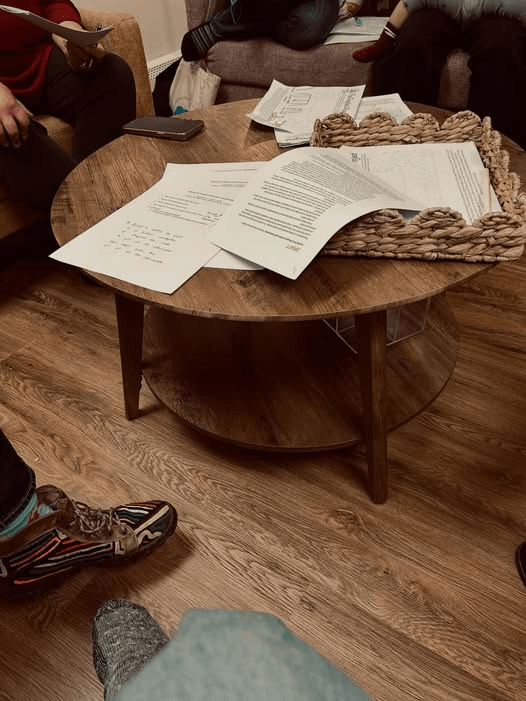
And then a few months later, the playground in Central Park was removed to fully remediate the soil and prevent other already ailing trees from dying. While there was a flurry of confusion mixed with blame swirling around the process, one thing was clear: regardless of how or why it happened, there was an earnest need for a playground plan, and a wide swath of people wanted to help make it happen. So I joined a collaborative effort with a few of my neighbors to spearhead the placemaking design of the playground. We called ourselves the “People’s Playground Project”.
Because nothing says cronyism like people who previously cared about something volunteering to still care about something.
The People’s Playground Project
This project was different from the start. In placemaking projects around Honesdale in the past, I’ve been lucky to have a single co-project manager. All of these projects center around community involvement, but finding people who can put in the time to manage the project for free is often hard. For comparison on how much work this is, official public projects typically have 15-20% of the total budget dedicated to project management. For a project of this size, that would be about $60-80K for everything, with perhaps about ¼ of that being allocated to the design concept phase (what we’ve just finished).
The placemaking work that Lisa does is often included in grant funds, but she had to go and do it for free before any grants arrived.
Yet we began with five individuals who were dedicated to managing the project, and eight more have joined the team (with many more contributing in small and impactful ways). And instead of paying $15K or beyond to get to this here, we’ve put in more than 700 hours and spent around $143 total on supplies. Furthermore, everyone who has expressed interest in helping has found a way to loop in: no one has been turned away or made to feel like they don’t have a meaningful skill to help move things forward.
While some claim that enough people weren’t involved, it seems that strangers and those who disagreed weren’t left out like they usually are.
This process also means extending the same trust that the Borough Officials are showing in us to anyone else involved in the project: If someone says they’re going to call a potential supplier, we trust them to do that. If someone says they’re going to put on a basket raffle, we trust them to do that. If someone says they’re going to read the Playground safety manual to better critique our design, we trust them to do that. We also make sure that everyone is in the loop enough to step in to help when things don’t go as planned:
Because we all know that, instead of trusting people, real leaders micromanage their volunteers until they give up on doing good and leave.
I was supposed to be running the final workshop for “Step 2” of our Placemaking process, meeting on zoom about inclusivity with a wide array of parents when my connecting flight back from Oklahoma (where I had run a couple of in-person placemaking workshops) was delayed…first by twenty minutes, then by an hour, and ultimately by six hours. We ended up taking off from Chicago just as the workshop began: the perfect wrong time for Placemaking-lead-me to have to have no WiFi.
So basically, Lisa Glover dropped the ball when her paying job interfered with her volunteer work, when she could have just told the pilot to wait.
Fortunately, two other PPP folks were available and well-versed enough in the process to jump in. What could have been a disappointing moment for community members who are used to excuses when it comes to their kids became an opportunity to ensure that the playground design could meaningfully meet at least some of their needs. It also earned us an additional core team member—someone who didn’t know how she’d take on another project, but jumped in anyways because she knew how impactful it would be.
And that’s the real risk of placemaking—it can make community members take on more work and see their own impact on the place they live.
Final Words
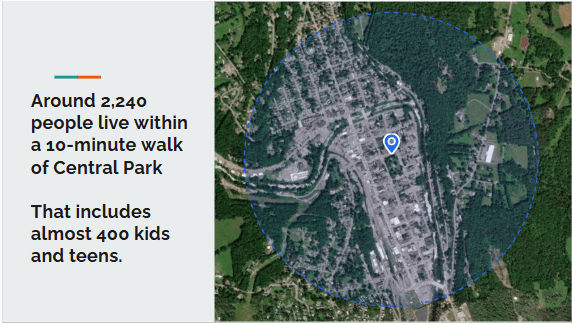
Overall, the four-step placemaking process we followed took into account a wide array of needs and dreams. Central Park is Honesdale Borough’s park with the greatest number of people who live within a 10-minute walk: it needs to be a place that can function as a lot of things for a lot of folks.
And in a place where every other park’s main amenity is trees, it sure is a travesty that the PPP is ruining the view of some of the trees with this proposed playground. Furthermore, what of the classic motto “they don’t know what’s good for them.” Why is the PPP challenging that?
But with that, it will never be everything to everybody. It can’t be all open space. It doesn’t make sense to have large, one-user-at-a-time objects. It likely won’t have all synthetic surfaces. Not everything will be gated. It will have some more trees and plants than are there currently, but there may be people who find colors like light blue and dark green to be garish. Heck, some people will even disagree with teens having equipment that is geared towards them taking up public space.
It’s a slippery slope. You allow teens to have space to exist in public, and the next thing you know they’ll want to be here their whole lives.
That said, Placemaking is a process. We’ve gotten somewhere good, and we’re fine-tuning the details as we learn more together as volunteers. We’re thankful for the Borough’s vote of confidence. And when we see examples of paid projects like the Wayne County Comprehensive Plan update and the Honesdale Revitalization Plan that were put on by well-respected planning firms, and see that they have 329 and 550 participants in their processes respectively, we can be damn proud that a group of volunteers managed to listen to and incorporate feedback from more than 1,600 people in the process of reimagining a much smaller place. So we hope that you’ll join your neighbors and work on what matters most to you. It’s not a club; there’s space for everyone in it.
And in case this hasn’t convinced you that Lisa Glover is not what she seems, just show up to a Borough Council meeting where she’s known for making a clown of herself by juggling and making seal impressions. What a weirdo!
Cheers,
Lisa
 Gravity Studios